
Author: eiacocca
Pseudospectral method resolves atomic scale dynamics

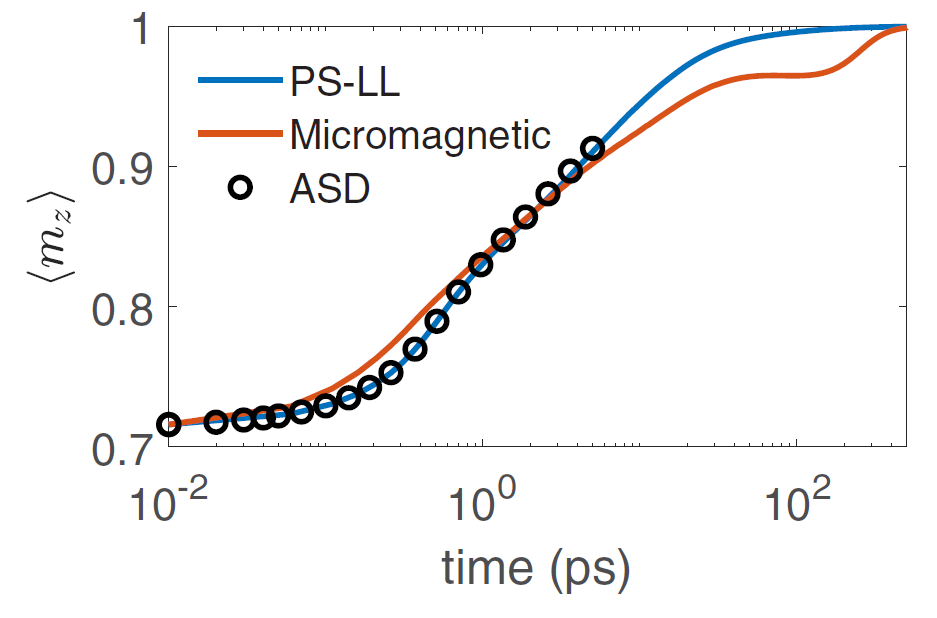
We have published a new continuum method that resolves atomic-scale magnetization dynamics with good accuracy. The method is pseudospectral and so is amenable to analytical calculation. Limiting cases of modulational instability (a long-wave phenomenon) and transient grating (a regime where long and short waves co-exist) were resolved in excellent agreement with atomistic spin dynamics. We expect this model to be the foundational stone for a better modeling of topological textures.
Fantastic work by Kyle Rockwell on this research and special thanks to our international collaborators Joel Hirst and Thomas Ostler.
This research was supported by the U.S. Department of Energy, Office of Science.
Lawrence awarded Barry Goldwater Scholarship
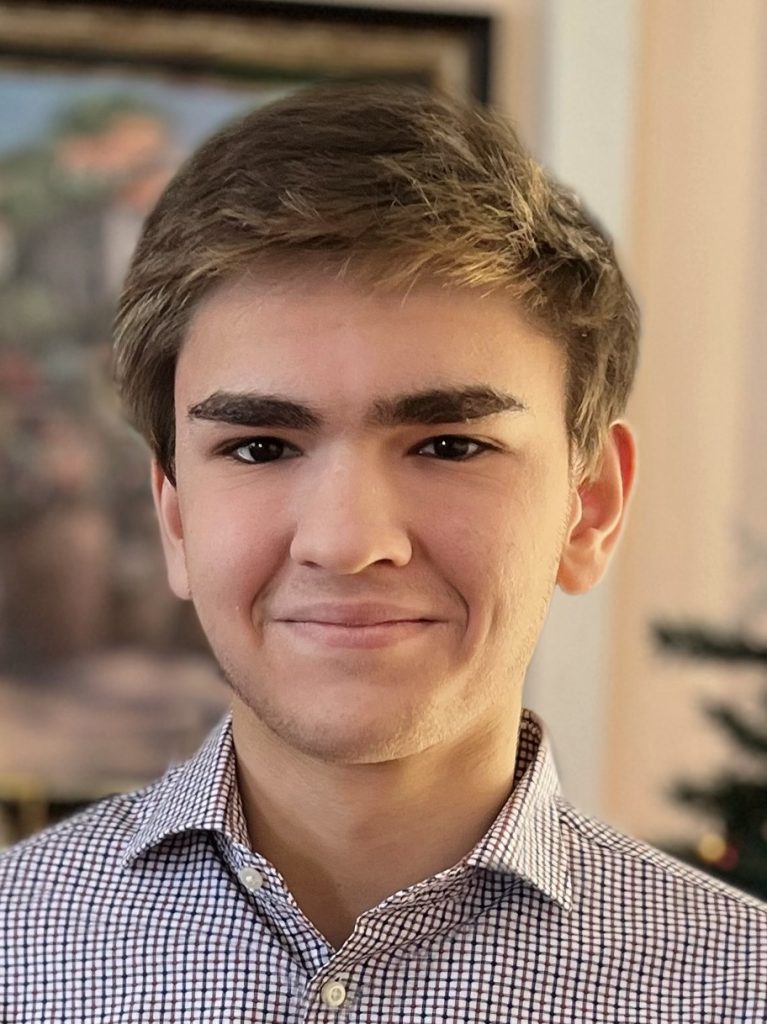
Congratulations to Lawrence who was one of the awardees of the Barry Goldwater Scholarship 2024. This is one of the most prestigious federal scholarship in the natural sciences. It’s scope is to support undergraduate students “who intend to pursue research careers in the natural sciences, mathematics and engineering […] helping ensure that the U.S. is producing the number of highly-qualified professionals the Nation needs in these critical fields.”
Lawrence has performed exceptional research in our group including the modeling of resonant and propagating modes in macroscopic artificial spin ices and micromagnetic modeling of magneto-toroidal spin ices, both graduate-level research topics.
Congratulations again to Lawrence for this well deserved recognition.
Ghanem and Ezio present at March Meeting

We attended March Meeting 2024 in Minneapolis. Ghanem presented an excellent talk about our ongoing work on tilted artificial spin ices. Our colleague Prof. Bozhko from the uMag group also presented about our collaborative work on a macroscopic artificial spin ice which was very well received by the audience.
We also got to learn what early career physicists are more interested about! (see picture)
Nano-magnonic crystals
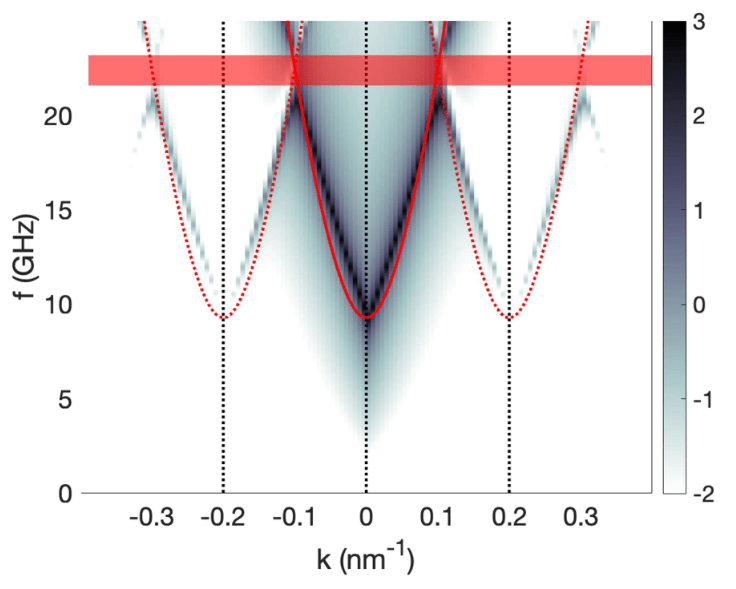
Ally published her first-author investigation of magnonic band structure in nano-magnonic crystals. These are magnonic crystals with parameters modulated at the nanoscale which could leverage new techniques in material science with tens of nanometer resolution. Congratulations Ally!
The paper can be found at Magnetochemistry 10, 14 (2024)
Elettra showcases domain wall motion
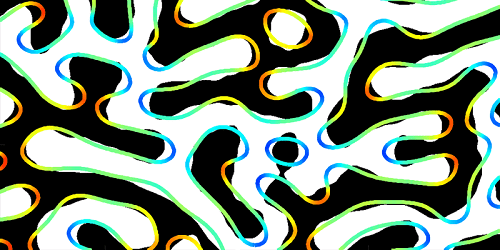
Our recent work on ultrafast domain wall motion due to ultrafast excitation was recently showcased as a top story at the Elettra Sincrotrone Trieste. We are very happy about the attention this work is receiving and the opportunities it opens for future research.
Our group’s contribution to this work has been also highlighted in UCCS’s communique article.
Ultrafast domain-wall motion
We are very happy that our work on ultrafast magnetization dynamics has been published in Physical Review Letter as editors’ suggestion and featured in the Physics magazine. This collaborative work features experiments performed at FERMI free-electron laser in Italy. Based on the data, we were able to discern changes in the scattering and link them to curvature-dependent distortions in the domain pattern. Congratulations to all authors and special mention to Kyle’s work and contribution to this research!
The paper can be found in Phys. Rev. Lett. 131, 256702 (2023)
Published method for general ASI magnon band structure
Our work on Gænice has been published in J. Magn. Magn. Mater. 589, 171603 (2023). Very nice piece of work that will allow us to explore new artificial spin ice geometries with exciting magnonic functionalities.
The code is free to use and can be downloaded from our repository.
Successful comps!
Medhanie, Ally, and Ghanem successfully became PhD candidates this fall. Congratulations and well done!
Pietro concludes his visit to the group

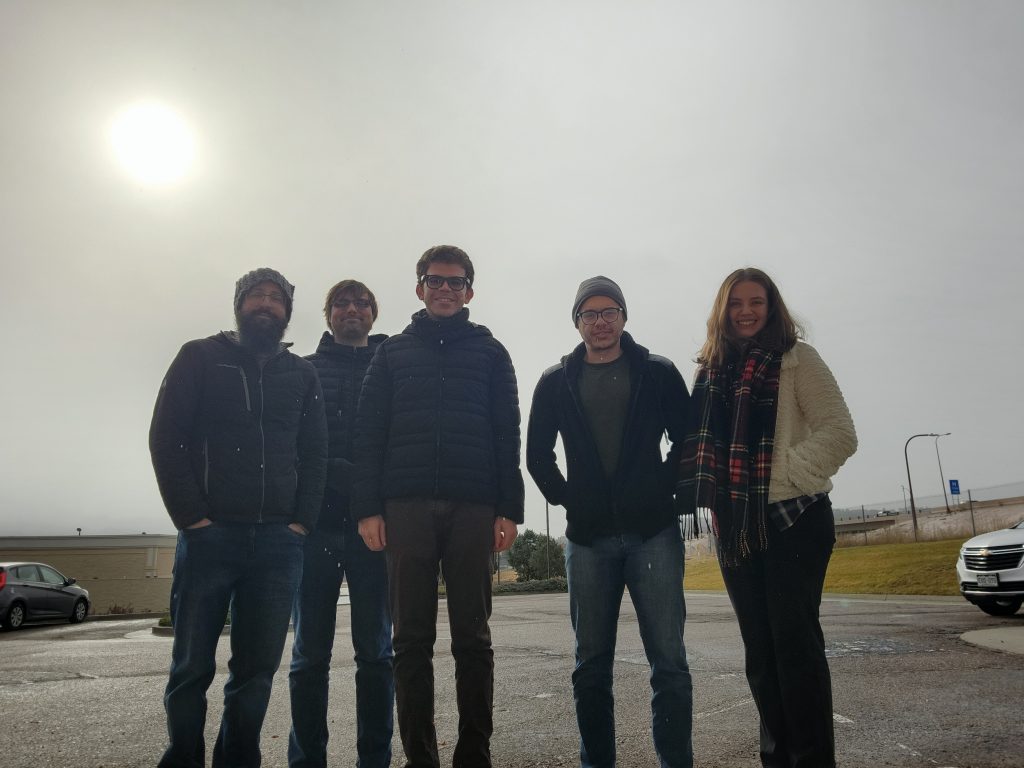
Pietro Micaletti visited us for two months to investigate spin wave dispersions in textured magnetic thin films. It was a very productive research and we are looking forward to continue our work with him and Prof. Montoncello. Unfortunately, the weather did not agree for the photo!
Numerical approach to approximate demag factors
Our method to determine demag factors for stadium-shaped nanoislands has been published in IEEE Magnetic Letters. This approach goes in tandem with Gænice to obtain a quantitative agreement with Kittel’s equation using the approximation of a diagonal demag tensor. The level of accuracy obtained allows us to resolve the resonant frequencies at low bias fields, as it is often the case in artificial spin ices.